Yesterday’s Abused Becomes Today’s Abuser: Cyclic Tales of Child Domestic Workers Amidst Enduring Advocacy
On the evening of 5 March 2025, a 12-year-old girl we will call Amani found herself lost in the streets of Nairobi. Earlier that day, she had been removed from school by her uncle in Kitale and placed on a bus to Nairobi, all alone and without food. Her mother had agreed to the move because she was told it was to help Amani continue with her education. When Amani arrived in Nairobi, no one was waiting for her. She sat at the bus station for twelve hours until her cousin finally picked her up. At her cousin’s house in Githurai 44, she was confronted with the harsh reality of her new life. Instead of being enrolled in school, she was made to work as a domestic worker, caring for a seven-month-old baby and handling all the household chores, including cleaning the house, utensils, and clothes all under the promise of a meagre monthly salary of Kshs. 800 (approx. 6$). She was expected to complete all the chores while surviving on two meals a day; porridge in the morning and a modest dinner. Her pleas to be taken back home and be enrolled in school fell on deaf ears.
Efforts to Break Free
Amani knew this was not the life she deserved. In a desperate bid for freedom, she attempted to escape her employer’s home. But the unfamiliar and overwhelming streets of the city proved too difficult for her to navigate. Stranded and frightened, she was discovered by a neighbor who, returned her to her abuser. In response, the employer and her husband tied her hands and legs and brutally beat her with a mwiko a common Kenyan kitchen utensil that, in many households, also serves as an instrument of punishment.
Yet, Amani did not lose hope. On April 5th, 2025, she made another escape, this time successfully. Fortunately, a good Samaritan came to her aid, guiding her to Kasarani police station. Here she found refuge in the Child Protection Unit (CPU), manned by officers who are trained on multifaceted character and modes of addressing exploitative child domestic work by Amka Africa Justice Initiative. The unit liaised with the Children Office to find Amani a temporary shelter at a nearby children’s rescue centre as the rest of issues were addressed.
Fight for Justice
The Child Protection Unit also reached out to Amka Africa for support to solve the case, especially the civil aspects. The police summoned the employer to the station, and as the investigation deepened, even more disturbing details emerged. Shockingly, the employer herself was a survivor of exploitative child domestic work and was now inflicting the very same harm she once endured, continuing a painful and tragic cycle of abuse. The employer used to live with her stepfather and mother in Kitale. The stepfather defiled her severally. This made her run away from home to Umoja in Nairobi where she started working as a domestic worker at 10 years.
Upon analysing the cyclic abuse and situation of the employer as an ignorant survivor of child domestic work (CDW), the team (Kasarani police station CPU, the Children Officer and Amka Africa) quickly realized that this was a case where an arrest could only cause further harm to the employer and her baby. We chose mediation to recover wages owed to Amani and raising awareness of the employer on the dangers of cyclic exploitative child domestic work and legal implications. An agreement for payment and a commitment by the employer to join advocacy against child domestic work in her neighborhood was recorded. The employer was also tasked to facilitate Amani’s return to his parents in Kitale.
The Road Back Home
With the case successfully mediated, Amka Africa worked with the Department of Children’s Services and the National Government of Administration Officers (local chief and assistant chief) to trace Amani’s family. In June 2025, our team finally began the long journey to Kitale, hoping that Amani would be reunited with her family and resume school.
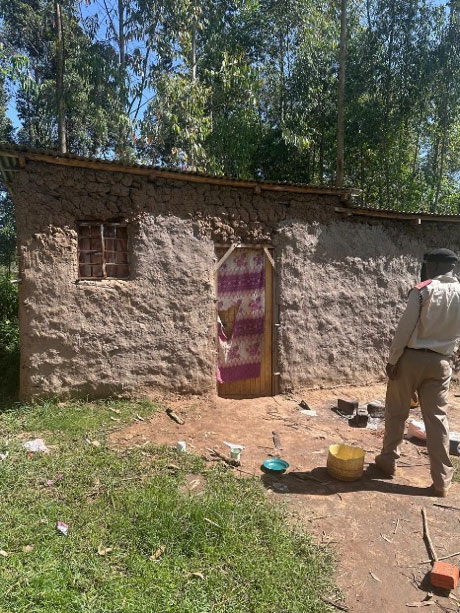
However, upon arrival, we were met with yet another heartbreaking reality, Amani came from an extremely vulnerable household with her primary guardians being her mother, grandmother and a few aunts and uncles. Her mother has four other children of ages 19, 13, 11 and 5 years respectively. The 19-year-old first born has a 2-year-old daughter who also lives with the mother. The mother struggles with alcoholism and is periodically absent.
As part of our advanced advocacy campaign against child domestic work in the source regions such as Kitale, we visited the school Amani and her siblings attended and established that Amani’s 19-year-old sister had dropped out at Standard 3, the 13 and 11-year-olds were enrolled in school but were periodically absent. All the children were particularly behind considering their ages and the grades they were in. None of the children had a birth certificate because their mother does not have a national identity card a mandatory requirement for birth registration.
On the other hand, the grandmother lives with 5 grandchildren, three of whom belong to one of her daughters who passed away at 22 years having been shot during protests in Kakamega and the other two to another daughter and son. Only two of these children were enrolled in school although they were also periodically absent. The chief had tried tracing the fathers to the first three children to no avail. The grandmother was not sure of the names of the children. The three children left by the deceased daughter did also not have birth certificates as their mother died without an Identity Card.
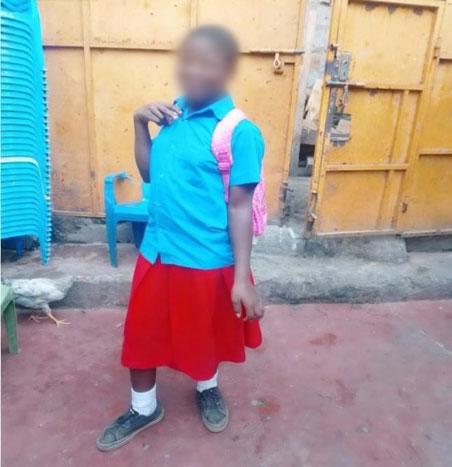
Amka Africa convened a meeting with Amani, her primary guardians, the area chief, the nyumba kumi (village) elder, and the children’s officer to agree on a way forward regarding her wellbeing and education. The guardians were sensitized on the risks of exploitative child domestic work and the importance of Amani resuming school. Amani’s mother and grandmother expressed serious resource constraints and concern that, within their current environment, Amani could face the same risks as her older sister, including school dropout, sexual abuse, and teenage pregnancy. They appreciated Amka Africa’s efforts in tracing Amani’s home and facilitating her access to justice, and requested support to enable her to continue her education if possible. Previous consultations with the rescue centre where Amani had been temporarily placed indicated that, should home tracing not be in her best interests, she could continue attending the school she had been enrolled in while residing at the centre in Nairobi. This option was discussed with Amani and her guardians, who unanimously agreed it was in her best interests. With the approval of the local authorities, it was agreed that Amani would return to the rescue centre in Nairobi, be enrolled in school to continue her education, and be allowed to visit her family during school holidays under close supervision.
Amka Africa also conducted a sensitisation talk with the local school headteacher who joined our anti CDW campaign and promised to monitor the school attendance of Amani’s siblings and cousins and not chase them away from school for any reason. The mother and grandmother were also instructed to visit the school the next day under the Chief’s supervision, with all the other children not enrolled in school. To ensure proper registration of the children in school and Mama Amani’s ability to engage in meaningful economic activity, Amka Africa facilitated her to acquire a National Identity Card.
Amani’s story is a powerful reminder of the complex and cyclical nature of exploitative child domestic work and the deep-rooted causes that continue to push children into harmful work conditions. The story also a hopeful insight on the power of partnership and enduring advocacy to make exploitative child domestic work Not Invisible Anymore!